
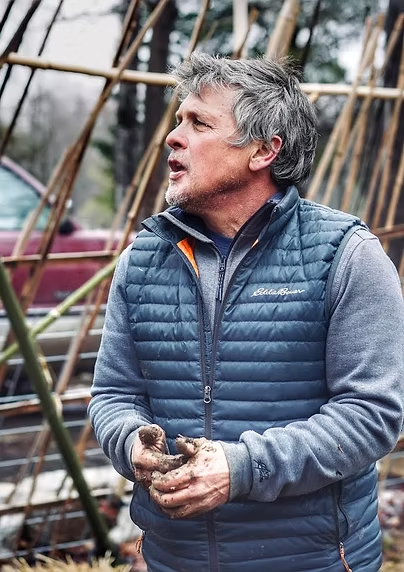
Zach has been the main force behind our four year garden grant from the Daofeng and Angela Foundation and the Bedrock foundation, literally building our vegetable gardens from barren ground, creating beautiful forest views, and helping to establish our many flower beds. Zach began his career in alternative gardening at the age of 16 when he worked maintaining meadows with a sickle bar mower. He then worked with a large landscape crew that constructed landscapes planting 50 large trees a day. Between 1988 and 1994 he lived in a commune in Ireland that produced its own food for domestic use. From these roots he developed his passion for restoring native woodlands, landscape design and restoration. In 1998 he started his company “Tree and Leaf” that produced market vegetables year round on Over the Grass Farm in the Plains Virginia, specializing in winter production. After marrying in 2001 he returned to Waterford to tend private gardens and run a CSA in Loudoun County, producing not only food, but cut flowers and stock for landscapers. Eventually this led him to rent land at Wheatland Farm, a farming cooperative where he grew his reputation selling to high end restaurants and farmer’s markets in DC. The challenges of making land decisions while working on leased land, convinced him to apply for a USDA loan and buy his own farm in Orange, Virginia. Under Tom Vilsak’s Department of Agriculture, his influence grew as Michelle Obama promoted the Know your Farmer Know your Food program and he came to be an important player in the DC food scene working on the booming popularity of good food and food education. In 2016, wanting to return home to Loudoun County, he merged with Potomac Vegetable Farm for two years. Now Zach’s company Tree and Leaf does farm and garden contract work restoring both woodland and meadow, managing large pastures, and wildflower restoration. He is an expert on managing and improving soil, and use of plants to do that work. He has a passion for no-till cropping. When he came to China Folk House four years ago, there was no soil to work with, but Zach has diligently built our vegetable garden from a pit in the ground. Anyone who has seen our garden knows Zach is a true alchemist creating abundance where abundance was absent.
Interview
What are your reflections on the past year at the Folk House?
Last year the soil in the garden really started to show that it was coming alive. We did hugelkultur, which is a German farming and gardening technique, ‘hugel’ meaning ‘hill or mound’-culture. So all of that work has taken a couple of years, with drainage and biology, for the mycorrhiza to be established and the whole garden to act as a system. Last year really felt shortened in terms of harvest and activity in the garden, but the response in the crops that we planted was pretty good. It was a challenging year, of course, because it was extremely hot. I was interested and excited by how the garden was keeping moisture in such incredible heat—that means that moisture is deep in those beds and plants are reaching deep into the soil to find that moisture. Great stuff.
This garden is strictly a non-tillage garden. We’re not inverting the soil, we’re just adding to the soil and growing cover crops and crimping them down, and those cover crops become mulch and we plant into them. A success for me was that we grew some winter wheat, harvested it, flailed it, winnowed it and made flour and ate it. Being able to make a full circle with the students is inspiration for more planting and showing how we can grow cover crops, some just specifically for soil health. I experimented with replanting summer crops from the kitchen compost in the place where we’d harvested the wheat and we had incredible peppers and tomatoes. So that was exciting. All of those signs of vitality in the garden show that the system is really coming together.
This past year there’ve been some really magical ‘a-ha’ moments with whole groups of people of all ages and with individual students in the garden, where they understood that “oh, plants make soil”—rather than “I’m this person who brings in soil and does things to the soil that helps plants.” It’s actually the power of photosynthesis that’s the ultimate tool of good soil. I mean, everyone shares the same value that we all like to eat food, right? But not everyone shares the understanding of where the food is coming from.
What are your hopes for this next year at the Folk House?
I want to incorporate the garden more so that it’s in people’s minds that they’re working with plants as a part of the folk house, instead of as a separate or extra thing. I definitely want to grow some more traditional Chinese crops. Maybe now that the soil’s in better shape we can try some more intricate things that the chef can work with as well as dry beans or something like that, maybe something that’s like a ‘Folk House product.’
And then one other thing I really hope for is more garden-to-table events. I have a lot of experience doing farmers markets throughout the DMV for 20 years and working with different chefs and food organizations—there’s definitely a wealth in this area of great collaborative foodie people. So, getting more integrated with broader food systems and getting on the map a little bit seeing as we have such a nice space. We have a great kitchen and a great space where people can enjoy their food as well as be entertained and educated. And the food is here. We’re ready—there’s the opportunity to have it to be a venue for more multicultural experiences and make money for the Folk House. We’ve had some challenging weather conditions for some events, but in this space, once everyone arrives this strong sense of place always comes together.
Why do you choose to be involved with the Folk House, and what does it mean to you?
I want to be of service to my community and this project. It takes a village. I’m really inspired and encouraged by the vision of this place—it has surprised and continues to surprise me how, when people come together here, through the workforce as well as through the events and the student programs, the whole thing works. It can be very chaotic. It’s a lot, but we bring it together. When you get people to this place that’s removed from the outside world and surrounded by trees and nature, people don’t know what to expect. I’ve brought farmers here and they’re like, what is this place? Why is it here? Why? And then at the end they’re so excited and understanding that, wow, this is a really significant place. Learning about Chinese culture, working with Chinese people in the garden—it’s been really rewarding to have that exchange.